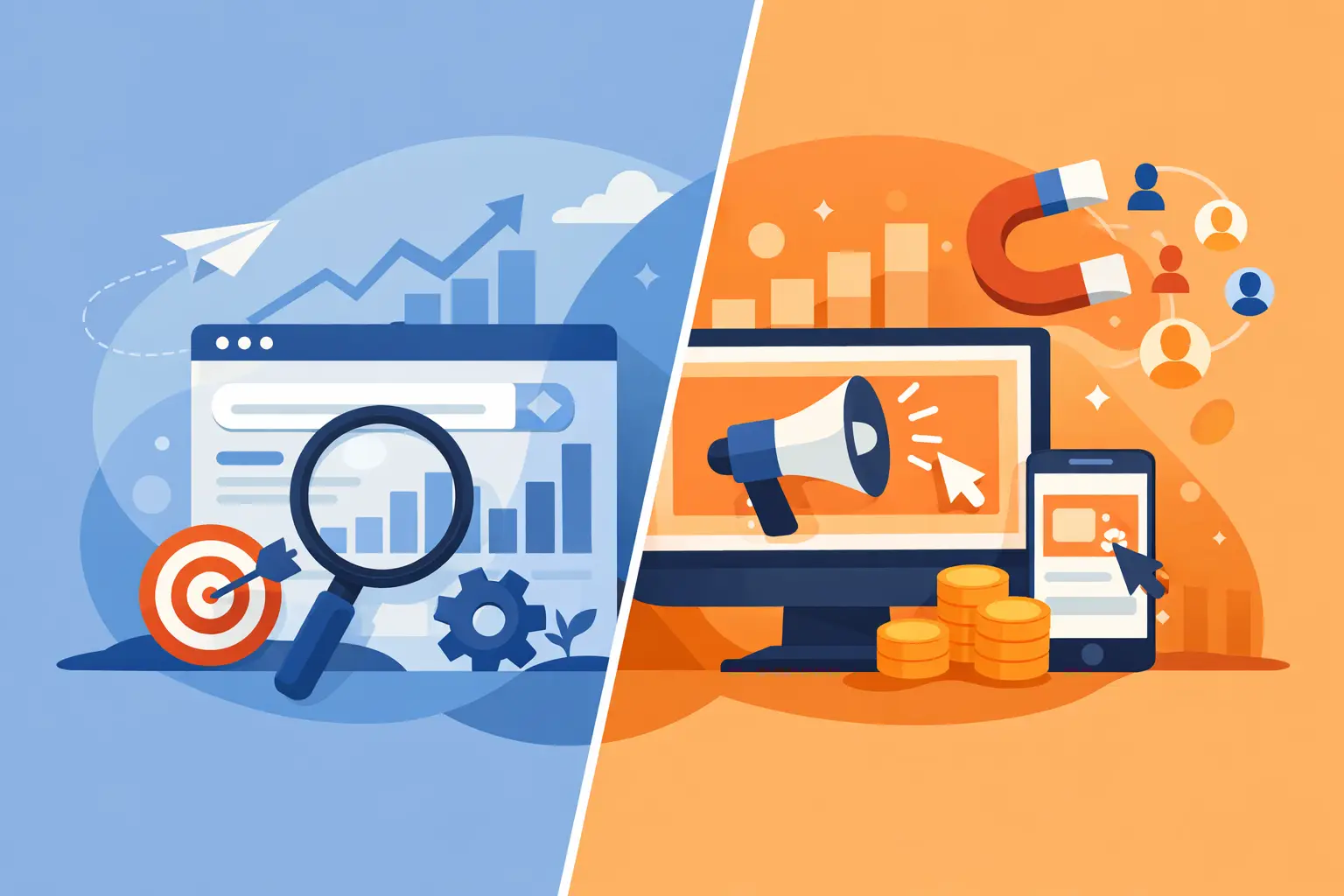
A lot of small businesses ask the wrong question. They ask whether SEO vs paid advertising is better, as if one channel should win and the other should be cut. In practice, the better question is which channel solves your current business problem with the least waste.
If your pipeline is thin this month, you may need leads fast. If your cost per lead is climbing, you may need stronger organic visibility to reduce dependency on ad spend. If your market is competitive and your budget is limited, the right answer is often a staged mix rather than an either-or decision.
SEO vs paid advertising: the real difference
SEO and paid advertising both help people find your business. The difference is how traffic is earned, how quickly results show up, and how costs behave over time.
SEO improves your visibility in organic search results. You invest in technical improvements, content, on-page optimization, and local search signals so search engines understand your site and trust it for relevant queries. The payoff is that traffic can continue after the initial work is done, although rankings still need maintenance.
Paid advertising puts your message in front of a selected audience immediately. That may mean paid search, display, social ads, video, or local media placements depending on your goals. You pay for exposure, clicks, leads, or conversions, and performance can move quickly. The trade-off is simple: when you stop funding the campaign, visibility usually drops with it.
Neither channel is automatically more efficient. Efficiency depends on your sales cycle, your margins, your market, and how well you measure performance.
When SEO makes more business sense
SEO tends to work best for businesses that need consistent lead flow over time and want to lower customer acquisition costs as their visibility grows. It is especially valuable when customers actively search for the service you provide, such as legal help, home services, healthcare, professional services, or local retail with clear purchase intent.
For a Tucson-area business, local SEO can be particularly useful because buyers often search with location intent even when they do not type the city name. They search for service categories, compare reviews, and choose from the businesses that appear credible and easy to contact. If your business is missing from those moments, paid ads can help, but they do not fix weak organic presence.
SEO also supports trust. Many users skip ads and go straight to organic results because they perceive them as more credible. That does not mean organic listings always convert better, but it does mean SEO can strengthen the buyer journey before and after the first click.
The downside is timing. SEO usually takes months, not days. If your site has technical issues, weak content, or no local authority signals, progress can be slow at first. Businesses that need immediate demand generation often get frustrated when they expect SEO to act like a switch they can turn on.
When paid advertising is the smarter move
Paid advertising is usually the better fit when speed matters. If you need leads now, are launching a new service, entering a new market, or promoting a time-sensitive offer, paid media can produce data and demand much faster than SEO.
It also gives you tighter control. You can choose geography, audience segments, keywords, budget caps, scheduling, and creative. That makes paid advertising useful for testing offers, identifying high-converting messages, and learning which services deserve more investment.
For small businesses with limited time, this matters. A paid campaign can quickly show whether people respond better to emergency service messaging, financing language, free consultations, or a specific call to action. Those insights are not just useful for ads. They can improve landing pages, website copy, and future SEO content.
The problem is cost discipline. Paid media can waste money fast if conversion tracking is poor, targeting is broad, landing pages are weak, or campaigns are left on autopilot. Visibility is immediate, but profitable visibility is not.
Cost, ROI, and the timing problem
This is where many decisions go sideways. Business owners compare SEO and paid ads as if one is free and the other is expensive. That is not how the math works.
SEO does not charge you per click, but it still requires investment in strategy, content, technical work, local optimization, and ongoing refinement. Paid advertising has direct media costs, but those costs can be justified if the campaign generates profitable leads quickly.
The practical question is not, “Which costs less?” It is, “Which gets us to profitable customer acquisition faster, and which creates stronger efficiency over the next 6 to 12 months?”
Paid advertising usually wins the short-term timing test. SEO often wins the long-term efficiency test. But there are exceptions. If a keyword is extremely competitive in paid search, your cost per lead may become unsustainable. If your website is weak and your market is crowded, SEO may take longer than expected to produce meaningful business results.
That is why channel decisions should be tied to clear benchmarks: lead volume, cost per lead, close rate, revenue per customer, and return on ad spend. Without those numbers, channel debates become opinion contests.
SEO vs paid advertising for different business scenarios
A service business with urgent demand, such as restoration, towing, or emergency repairs, often benefits from paid search first because timing drives conversions. If a prospect needs help now, being visible at that moment matters more than building a long-term content library.
A business with a longer consideration cycle, such as legal services, healthcare, B2B consulting, or home remodeling, usually needs both visibility and trust. SEO helps capture research-stage searches and supports credibility. Paid advertising helps stay visible for high-intent terms and remarket to prospects who are not ready on the first visit.
A newer business with little brand awareness may need paid media to generate traction while SEO groundwork is being built. An established business with steady referrals may use SEO to reduce overreliance on paid leads and improve margin over time.
This is where local market knowledge matters. Competitive conditions in Southern Arizona are not identical to larger metros, and that affects cost, targeting, and search behavior. A practical strategy should reflect the actual market, not generic benchmarks pulled from national averages.
Why the best answer is often both
For many small businesses, the strongest plan is not SEO or paid advertising. It is sequencing them correctly.
Paid campaigns can create immediate lead flow and generate conversion data. That data reveals which services, keywords, audiences, and messages perform best. SEO can then be focused on the highest-value opportunities rather than broad topics that bring traffic without revenue.
At the same time, SEO helps reduce long-term dependency on paid media. As organic visibility improves, you may be able to shift paid budget toward your most profitable campaigns, seasonal pushes, or competitive gaps instead of using ads to cover every lead source need.
This approach also improves resilience. If ad costs rise, strong SEO helps protect lead flow. If rankings fluctuate, paid media can stabilize demand while adjustments are made. The result is a marketing mix that is more durable and easier to manage against real business goals.
How to choose the right mix
Start with your timeline. If you need leads this quarter, paid advertising should probably be part of the plan. If you are focused on improving efficiency over the next year, SEO should not be postponed.
Next, look at your economics. If one new customer is worth significant revenue over time, investing in both channels may be justified even with a modest monthly budget. If margins are tight, you need stricter targeting, stronger landing pages, and clearer attribution before scaling anything.
Then review your foundation. If your website is slow, your forms do not work well, or your messaging is vague, neither SEO nor paid ads will perform at their best. Channel strategy cannot compensate for weak conversion paths.
Finally, measure what matters. Track qualified leads, booked appointments, closed revenue, and customer acquisition cost. Vanity metrics like impressions and raw traffic have limited value if they do not connect to sales outcomes.
A practical marketing plan should remove guesswork, not add to it. That is why RAM Consulting approaches channel decisions through performance, local market context, and business priorities instead of one-size-fits-all advice.
If you are weighing SEO vs paid advertising, do not look for a universal winner. Look for the channel mix that fits your timeline, your budget, and the kind of growth you can actually sustain.