
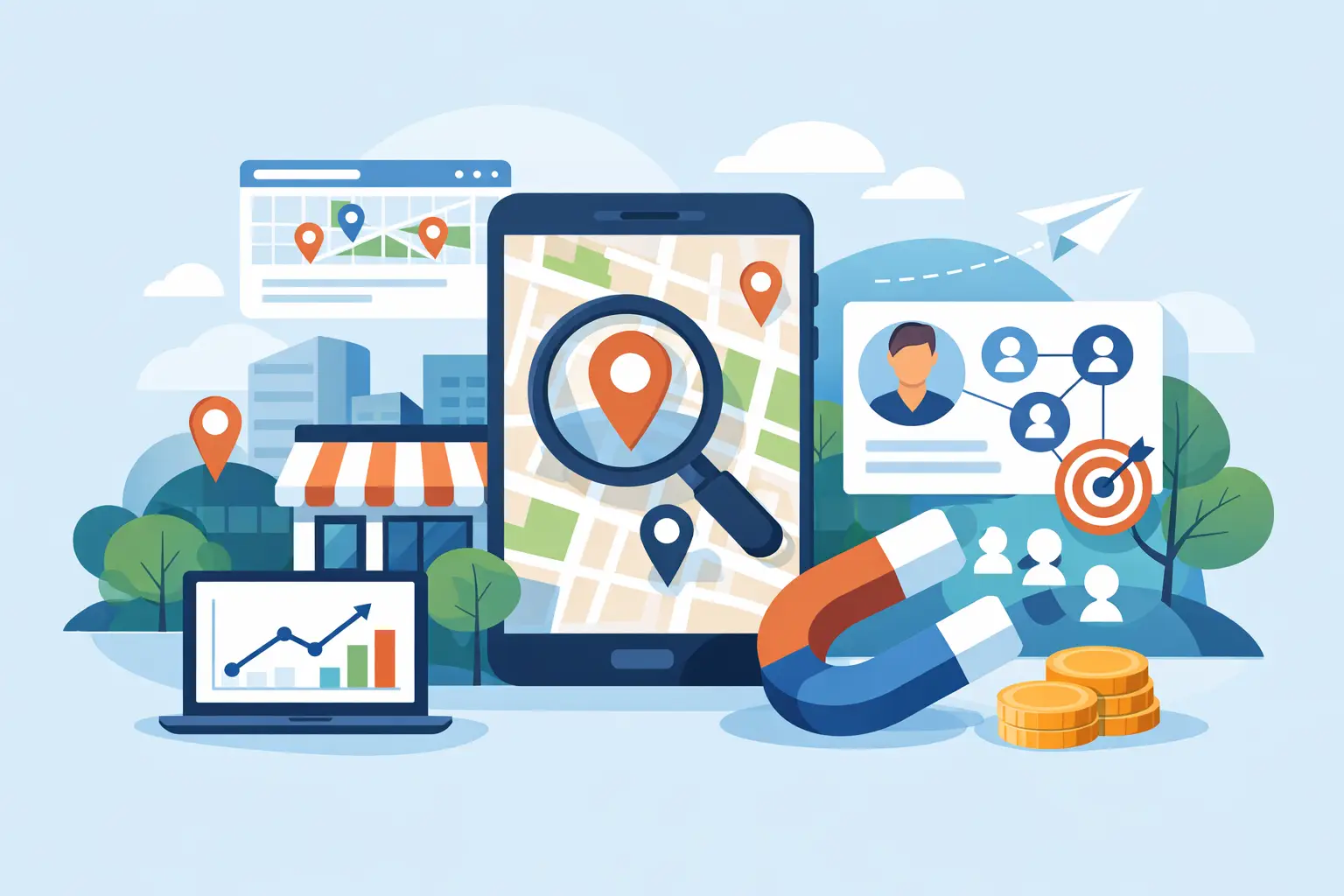
A customer searches “emergency plumber near me,” “best accountant in Tucson,” or “physical therapy Sierra Vista” when they are close to making a decision. If your business is missing from the map results or the first page, that demand often goes to a competitor before your website has a chance to make its case. This local SEO guide for businesses focuses on the actions that improve qualified visibility, reduce wasted effort, and connect search activity to leads and revenue.
Local SEO is not a one-time website project. It is an operating discipline: maintain accurate business information, publish useful local proof, earn trust signals, and measure what happens after a customer finds you. For small businesses with finite budgets, the goal is not to rank for every possible phrase. The goal is to appear when nearby, high-intent customers need the service you provide.
Start With the Local Search Results That Matter
A local search page commonly has three distinct opportunities: the map pack, standard organic results, and paid ads. A strong map listing can generate calls and direction requests without requiring a visitor to click through to your website. Organic rankings still matter because many buyers compare providers, review services, and look for proof before contacting anyone.
The right priority depends on how customers buy. A restaurant, home-service company, medical practice, or auto repair shop may get substantial value from map visibility and reviews. A B2B firm with a longer sales cycle may rely more heavily on service pages, case examples, and location-specific organic content. Most established local businesses need both.
Before changing anything, search for your core services from the perspective of a customer. Use non-personalized searches where possible, review the map results, and document who appears. Look beyond rank position. Note the competitors’ categories, review volume, review themes, photos, service descriptions, location pages, and calls to action. This creates a practical benchmark instead of a vague goal to “improve SEO.”
Build a Google Business Profile That Converts
Your Google Business Profile is often the first impression a local prospect receives. Treat it as a sales asset, not a directory entry. The business name, primary category, address or service area, phone number, hours, website, services, photos, and description should all be accurate and current.
Choose the most specific primary category that matches your main source of revenue. Categories influence the searches for which Google may consider your business relevant, but adding every available category is not a strategy. Add secondary categories only when they represent real services you offer. A Tucson marketing consultant, for example, should not choose unrelated categories simply because they seem to have high search volume.
Complete the services section with plain-language descriptions. Use terms customers use, but do not force keywords into every field. If you serve a defined service area rather than receive customers at an office, configure the profile accordingly. Do not use a virtual office, a mailbox, or an employee’s home as a public storefront if customers do not actually meet you there. Inaccurate location information can create compliance problems and undermine trust.
Photos matter because they answer basic questions quickly: Is this business real? Is it professional? What should I expect? Use current exterior, interior, team, work-sample, and product photos where relevant. For service businesses, before-and-after photos or examples of completed work can be more persuasive than generic stock images.
Keep Core Information Consistent
Your name, address, and phone number should match across your website, Google profile, social profiles, industry directories, and local listings. Small formatting differences are usually manageable, but conflicting phone numbers, old addresses, duplicate listings, or inconsistent business names create confusion for customers and search engines.
This is especially common after a move, rebrand, or change in call-tracking provider. Audit major listings after any operational change. If you use tracking numbers, preserve a consistent primary business number where appropriate and make sure tracking does not break the customer experience.
Create Website Pages Around Services and Locations
A Google Business Profile alone rarely supports sustained local visibility. Your website needs clear, useful pages that explain what you do, where you work, and why a prospect should contact you.
Start with the pages that align with revenue. A roofing company may need separate pages for roof repair, roof replacement, and commercial roofing. A law firm may need focused pages for each practice area. Each page should explain the service, the customer problem it solves, the process, expected next steps, and a direct way to call or request an appointment.
Add location relevance naturally. Mention the communities you genuinely serve, local conditions that affect the service, and evidence of work in the area. For a Southern Arizona business, that might mean discussing monsoon damage, desert HVAC demands, regional permitting considerations, or service coverage across Tucson, Sierra Vista, and nearby communities.
Avoid creating thin pages that simply replace one city name with another. If the content, proof, and service offering are identical, those pages add little value and can become a maintenance problem. Build a location page only when you can make it specific and useful, such as a staffed office, a meaningful service-area focus, local projects, customer examples, or distinct operational details.
Make Contact Easy on Every Device
Local search traffic is often mobile traffic. A prospect may be standing in a parking lot, sitting at home after hours, or dealing with an urgent repair. Your phone number should be easy to tap, forms should be short, and key calls to action should be visible without a long scroll.
Speed also affects results. A slow site loses impatient visitors and can weaken organic performance. Compress oversized images, remove unnecessary scripts, and test forms regularly. The best-ranking page has limited business value if its contact form fails or its phone number is hard to find.
Earn Reviews With a Process, Not a Last-Minute Ask
Reviews affect trust, click behavior, and local visibility. More importantly, they give potential customers independent evidence that your business follows through. The strongest review strategy is simple: ask consistently after a successful customer interaction.
Train staff to request feedback at the right moment, such as after a completed job, resolved issue, successful appointment, or delivered project. Send a short follow-up message that makes the process easy. Do not offer incentives in exchange for positive reviews, and do not pressure customers about what to write.
Respond to reviews professionally, including negative ones. A short, calm response can show future customers that you take concerns seriously. Do not argue, share private customer information, or use a public reply to win a dispute. If an issue is legitimate, acknowledge it and move the resolution offline.
Review quality matters alongside volume. Specific comments about responsiveness, expertise, outcomes, and service areas provide more useful proof than one-word ratings. Over time, review themes can also reveal operational issues worth fixing.
Measure Leads, Not Just Rankings
Rankings are a diagnostic metric, not the final score. Local results vary by searcher location, device, competition, and search intent. A business can rank well for a broad phrase and still receive few qualified inquiries. It can also rank outside the top three for some terms while producing strong leads from branded searches, reviews, and service-specific pages.
Track the actions that indicate commercial intent: phone calls, form submissions, booked appointments, direction requests, quote requests, and qualified chats. When possible, connect those leads to closed revenue. This lets you compare local SEO performance with paid media, referrals, and other marketing channels using business outcomes instead of assumptions.
A practical monthly dashboard should show search visibility trends, website traffic from organic search, Google Business Profile actions, lead volume, lead quality, and revenue or pipeline value where available. Segment branded and non-branded searches if possible. A rise in branded searches may reflect stronger awareness, while non-branded service searches are often a clearer sign that new prospects are finding you.
Prioritize the Work That Fits Your Budget
Local SEO has compounding value, but it takes disciplined execution. Do not spread a limited budget across dozens of low-impact tasks. Start with the gaps most likely to affect leads:
- Fix inaccurate or incomplete Google Business Profile information.
- Resolve duplicate listings and inconsistent contact details.
- Improve the highest-value service pages and mobile conversion paths.
- Establish a repeatable review-request process.
- Track calls, forms, and booked appointments by source.
After that foundation is in place, expand content, local proof, citations, and technical improvements based on actual performance. A business with weak conversion rates may need website and offer improvements before investing heavily in more traffic. A business with strong conversion rates but low local visibility may benefit more from profile optimization, content, and authority-building work.
Local SEO works best when it reflects how your business actually operates. Accurate information, credible proof, useful service pages, and reliable measurement give search engines and customers the same answer: this is a legitimate business that can solve the problem. Pick one revenue-driving service, audit its local search path from search result to phone call, and fix the first point where a ready-to-buy customer could lose confidence.